

7 min read
⏱ 8 min read
Buy Now Pay Later services split purchases into 4-6 installments with no interest if paid on time, but charge fees of 25-30% on missed payments and can damage your credit score since many BNPL providers now report to credit bureaus. The convenience masks real financial risks for impulse buyers. Here is how BNPL actually works and what to watch out for.
The Fine Print Nobody Reads Before Clicking “Pay Later”
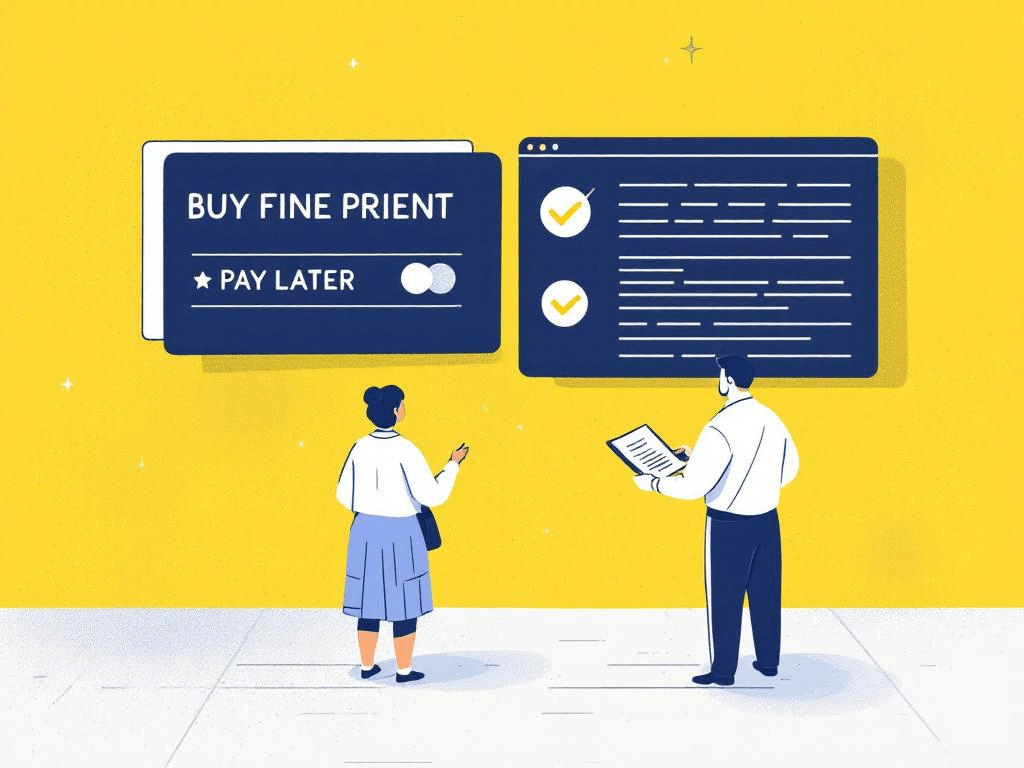
Buy now pay later buttons now appear at a significant share of major retail checkouts. Most people click them the same way they’d tap a debit card; reflexively, without much thought about what’s actually happening on the back end. That’s worth examining, because BNPL isn’t a payment feature. It’s a credit product with a specific incentive structure, and the companies building it are not neutral infrastructure.
Here’s a useful rule of thumb borrowed from fintech analysis: if you can’t describe how a financial product earns money, you don’t fully understand the risk you’re taking on. Many BNPL users, if asked, would say something vague about late fees or interest. That’s partially right, but it misses the more interesting mechanics. What follows is a closer look at how buy now pay later actually works, when the math genuinely favors the consumer, and when it quietly works against them.
What BNPL Actually Is (And Why It’s Not the Same as a Credit Card)

The core product is an installment loan, not a revolving credit line. The most common version — often called Pay-in-4 — splits a purchase into four equal payments over six weeks, typically with no interest and no fees if you pay on time. Each purchase is its own closed loan; there’s no running balance accumulating compound interest the way a credit card works. That structural difference is why BNPL can be genuinely cheaper for short-term purchases.
Affirm offers longer-term financing from 3 to 36 months with APRs that vary depending on the merchant relationship and the borrower’s creditworthiness. Some longer-term Affirm products trigger a hard credit inquiry rather than the soft pull most BNPL providers use; this matters if you’re managing your credit profile ahead of a mortgage application.
The 0% offers exist because the merchant is subsidizing them, paying Affirm a higher fee to make the financing appear free to the customer. The rate isn’t a default feature of the product; it’s a negotiated outcome between Affirm and whoever is selling you the mattress or the Peloton.
Klarna and Affirm have meaningfully different orientations. Klarna leans heavily on the short-term, interest-free model and has built a shopping app ecosystem around it. Affirm is more explicit about its longer-term financing and publishes APRs clearly; a genuine transparency advantage even when the rates themselves aren’t attractive.
When you click “pay with Klarna,” Klarna pays the merchant in full immediately. The merchant pays Klarna a fee on the transaction value. That merchant fee is the primary revenue driver, which means the consumer isn’t the customer in this relationship; the consumer is the product being delivered to the merchant.
The Business Model: Why “Free” Financing Isn’t Free for Everyone
Because merchant fees are the primary revenue source, BNPL providers are structurally incentivized to increase purchase frequency and average order value, not to help you spend conservatively. This isn’t a criticism; it’s just the incentive architecture. Understanding it helps you use the product with clear eyes.
Late fees are one place where Klarna and Affirm diverge noticeably. Klarna charges them; Affirm does not. That’s a real product difference, not a marketing distinction. If your cash flow is unpredictable, the no-late-fee structure is worth factoring into which platform you use.
There’s also a distinction worth knowing between true installment BNPL and deferred interest products. Deferred interest — common with store credit cards — charges you retroactive interest on the full original balance if you don’t pay it off within the promotional period. It’s a punishing structure. BNPL installment loans don’t work that way; if you’re on a Pay-in-4 plan, there’s no retroactive interest waiting to trigger. The two products can look similar at checkout but have very different downside scenarios.
Klarna’s shopping app is worth a separate note for anyone who pays attention to data privacy. The app aggregates your purchase history, tracks browsing behavior across partner merchants, and uses that data as part of Klarna’s broader business model and valuation story. You’re not paying for the app, which means the behavioral data is part of the exchange. That’s not unusual in fintech; it’s essentially the same model as most financial apps; but it’s worth knowing explicitly rather than discovering later.
When Buy Now Pay Later Actually Makes Sense
A purchase you were already going to make, financed at genuine 0% with no fees, is the strongest use case. If a merchant has subsidized a 0% Affirm offer on a laptop you need for work, you’re getting an interest-free loan for the financing period. The math is generally in your favor, provided you make the payments on time and the terms are what they appear to be.
Cash flow timing mismatches are a second legitimate scenario. You have a paycheck or invoice arriving in two weeks; you need the purchase now; you have the money, it’s just not liquid yet. BNPL as a short bridge may make sense here; it’s doing cash-flow work, not borrowing work, and that distinction matters for how you think about the commitment.
For the optimization-minded, there’s a minor but real arbitrage available: keep cash deployed in a high-yield savings account while using 0% BNPL to fund a purchase. Over a short Pay-in-4 cycle the dollar amounts are small, but the logic is sound; the same principle behind paying a credit card balance in full while keeping cash in savings.
Medical equipment, necessary home repairs, and business tools round out the list. If the alternative is a credit card at a high APR and a longer-term Affirm product is available at 0% or a low single-digit rate, the comparison may favor BNPL. In each of these cases, the purchase decision was already made independent of the financing option, repayment is certain, and the cost of the BNPL product is zero or close to it. When all three conditions hold, BNPL can be a useful tool.
When It Doesn’t Make Sense (The Specific Failure Modes)
Phantom debt is the most structurally interesting problem. If you have active loans with Klarna, Affirm, and Afterpay simultaneously, that total obligation doesn’t aggregate anywhere visible. Credit bureaus don’t consistently capture the full picture; no single dashboard shows your combined BNPL exposure across providers. You can become genuinely over-extended without some of the normal warning signals firing; a high utilization rate or a declined application would typically alert you, but BNPL fragmentation can prevent that.
Purchase-decision distortion is a widely observed effect, not a character flaw. Research suggests that installment framing tends to increase average order value; breaking a $200 purchase into four $50 payments can make it feel materially cheaper than it is. The psychological term is payment decoupling. Knowing about it doesn’t make you immune, but it gives you a concrete reason to pause before adding something to your cart specifically because BNPL made it feel affordable.
When longer-term Affirm financing carries a high APR on a discretionary purchase, the product may be worse than many credit cards. Affirm’s transparency about publishing APRs is genuinely useful; a 28% APR is a 28% APR regardless of how cleanly it’s disclosed.
Credit score implications are murky in ways that create specific risk. Affirm reports some products to Experian; other BNPL activity goes unreported; the rules vary by product and are still evolving. You might be building payment history that doesn’t help your score while carrying obligations that could affect your debt-to-income ratio in a mortgage underwriting process. The inconsistency creates real exposure.
BNPL stacked on top of existing credit card balances can compound cash flow pressure in ways that aren’t always visible until something breaks. Four separate payment schedules auto-debiting on different dates, alongside a minimum card payment, is harder to track than a single statement; errors tend to show up as late fees or overdrafts rather than as a clear signal that the total load was too high.
Two Questions Before You Click
The decision framework can be kept simple. Before using any buy now pay later product, ask two questions.
First: what is the actual cost? Find the APR, not just the “0% interest” label. Check whether late fees exist. Identify whether the 0% is merchant-subsidized or a promotional period with a different structure. This takes about ninety seconds in the product’s terms, and it’s the difference between using a free tool and paying for something you didn’t price correctly.
Second: would you buy this if you had to pay in full today? If the answer is no, the BNPL option is doing purchase-decision work, not cash-flow work. That’s a clear signal to pause. The financing didn’t create value; it created a purchase you wouldn’t otherwise have made.
On the practical side: Klarna’s app consolidates your Klarna activity; Affirm shows all active loans in its dashboard. If you’re using either platform regularly, those dashboards deserve the same attention you’d give a credit card statement.
BNPL is a well-engineered financial product. The companies building it have thought carefully about the user experience, the incentive structure, and the cognitive levers that drive adoption. Understanding that design is what lets you use it on your terms rather than theirs.
Want to learn more? Explore our latest articles on the homepage.
Enjoyed this fintech & crypto education article?
Get practical insights like this delivered to your inbox.
Subscribe for Free